
Modular by design. Autonomous by default.
A cube-shaped, lighter-than-air craft delivering a unique combination of capabilities that drones and satellites can’t: persistence, payload, and reconfiguration.

.webp)
Lift you don’t have to fight for. Power from the sun. Compute at altitude.
Hoverblox obtains lift from a lighter-than-air envelope rather than spinning rotors, directing almost all its energy into the mission instead of staying airborne. .This buoyancy includes what no rotorcraft can offer: a built in fail safe mode.
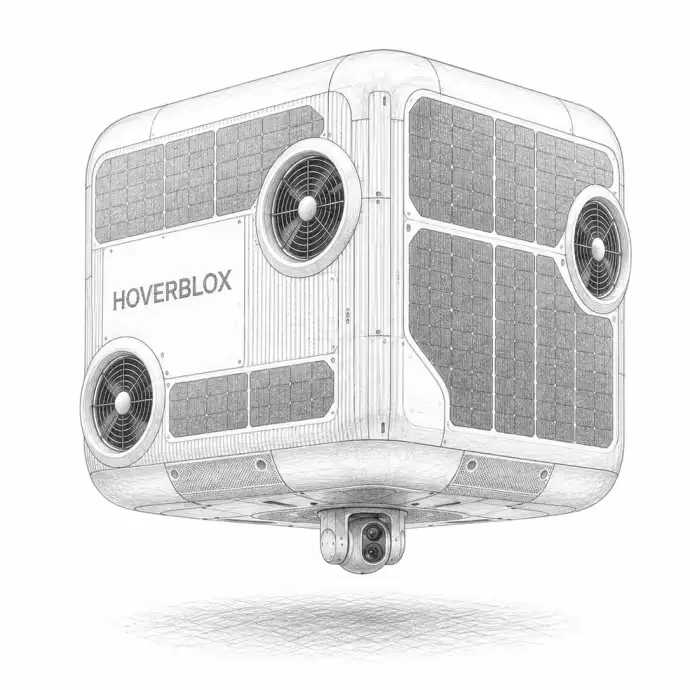
Modular airframe
— a (12 m)³ cube-shaped airframe enables rapid configuration for different missions while keeping manufacturing, integration and field maintenance simple.
Propulsion
— electric fans, powered by batteries and charged by solar cells complimented by built in buoyant lift, cut energy use by as much as 90% and extend flight time.
Endurance
— targeting 24-hour flight at 500 kg payload with loiter capability: ideal for ISR and weeks-to-months at HAPS altitudes.
Control
— throttled ducts deliver fine velocity control and 360° thrust-vectoring for precise station-keeping.
Structure
— an ultra-light composite carbon-fibre cuboctahedron increases payload capability and overall weight distribution and allows for flexible multi-unit configuration for efficiency, lifting more payload for less energy.
Power & data
— a flexible power and data architecture supports multiple powered payloads and toolsets on the same airframe.
Buoyancy
— a fully sealed lifting-gas envelope (hydrogen or helium) sits within a protective, electrically grounded mesh structure.
Redundancy
— an onboard flight-control system carries full redundancy of key flight and telemetry systems.

Ultra-long endurance
— ideal for persistent surveillance, communications relay and atmospheric research.

Rapid infrastructure deployment
— useful in disaster zones, remote sites and events with no traditional take off/landing facilities.

Massive payload volume
— floating labs, mobile infrastructure and multi-role mission pods on one platform and scalable to the mission.
.svg)
Modular & reconfigurable
— surveillance today, telecom tomorrow; one platform, many roles, no redesign.

Low-vibration platform
— superior to rotorcraft for ISR, geospatial mapping and scientific payloads.

Stratospheric potential
— high-altitude Hoverblox can serve as pseudo-satellites (HAPS): persistent coverage, lower latency than satellites, silent operation, and far easier maintenance and upgrade cycles.
Drones give you agility but not endurance.
Helicopters provide lift but need trained crews, burn fuel and create noise.
Satellites give you reach but cost hundreds of millions to commission and can never be serviced.
Hoverblox combines heavy payload, potential of weeks of endurance, ultra-low cost-per-kg and field
serviceability in a single platform that can deploys from a truck.
Hoverblox bridges the operational gap between incumbent technologies without their dependencies.
Full technical comparison available.
.webp)
.webp)
.webp)
Drones give you agility but not endurance.
Helicopters provide lift but need trained crews, burn fuel and create noise.
Satellites give you reach but cost hundreds of millions to commission and can never be serviced.
Hoverblox combines heavy payload, potential of weeks of endurance, ultra-low cost-per-kg and field
serviceability in a single platform that can deploys from a truck.
Hoverblox bridges the operational gap between incumbent technologies without their dependencies.
Full technical comparison available.
.webp)
Naturally fail-safe
— because lift comes from buoyancy, loss of power means a slow, predictable descent, not a free fall. Reusability and modular repair enable a platform to be in service for years.
Sustainable
— using up to 90% less energy than powered flight, with dramatically lower noise, and minimal local environmental impact, supporting net-zero targets across defence and commercial operations.